
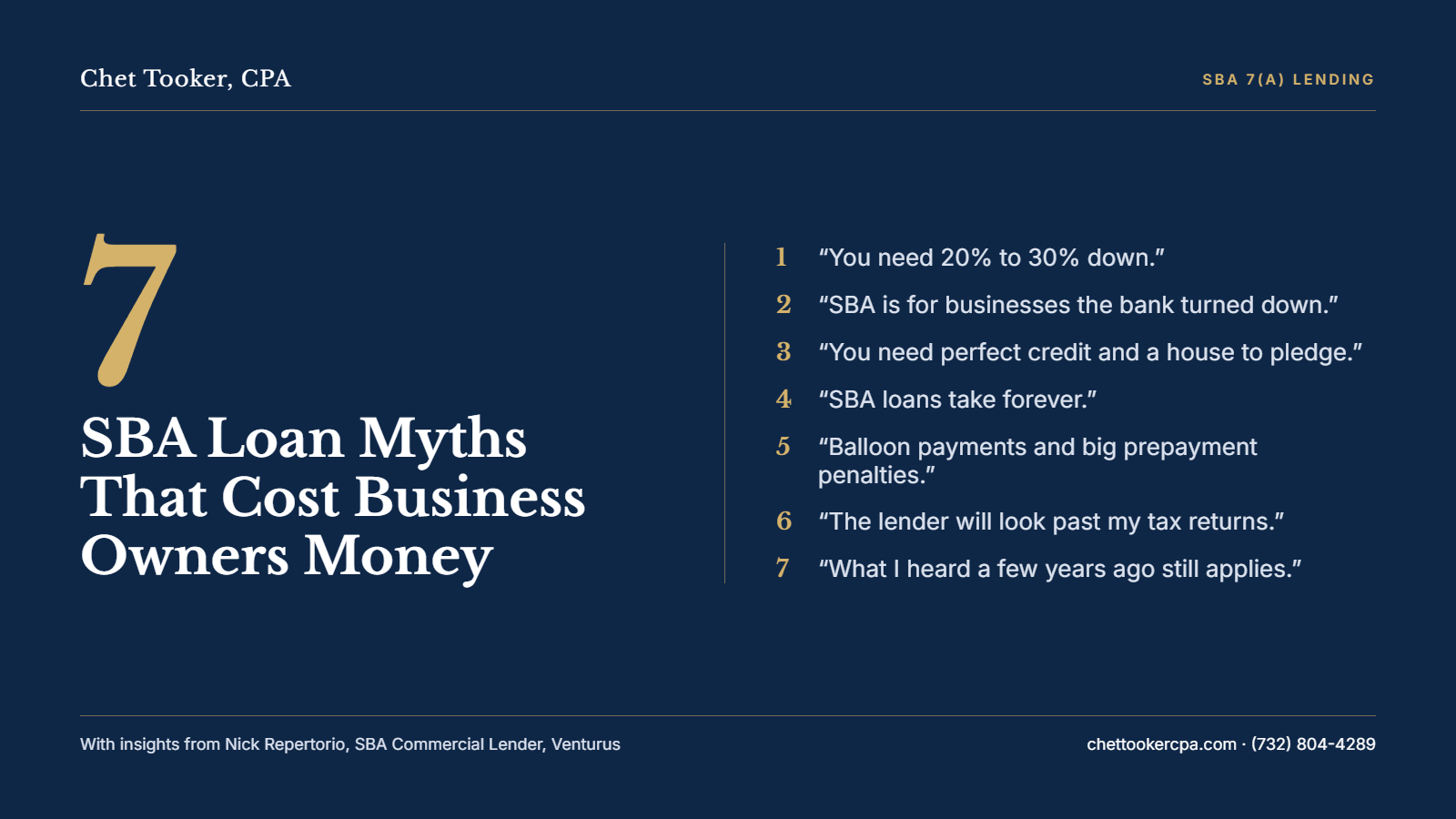
A business owner looking at a $1,000,000 building often assumes the purchase takes $250,000 or more in cash. That one assumption can end the conversation before a lender ever looks at the numbers. So I asked Nick Repertorio, an SBA Commercial Lender with Venturus, a division of Heritage Bank, which misconceptions stop qualified owners most often. Nick works on SBA 7(a) loans every day. Here are the seven he hears most, and what is actually true. "You need 20% to 30% down." For a conventional commercial loan, that is often right. Many conventional lenders want 25% to 30% down on a building. On a $1,000,000 property, that is $250,000 to $300,000 in cash before closing costs. SBA 7(a) works differently. For an established business buying or building the property it operates from, SBA sets no fixed minimum down payment. It leaves that call to the lender. For a qualifying established business, an SBA 7(a) loan can finance up to 100% of the project. That is a credit decision, not a guarantee. The lender starts with whether the business can carry the payment. "The question isn't whether you feel ready to buy," Nick says. "It's whether your business can support the loan payment." Three details matter. The business has to occupy at least 51% of an existing building (60% of one it builds new), so this is for owner-occupied property, not rentals. Start-ups and buyers of an existing business are different: they generally need to put in at least 10% of the project cost. And the lender has to consider the cash you and the business already hold. An owner with substantial liquid assets beyond reasonable reserves may be asked to put some of it in. "SBA loans are for businesses the bank turned down." Not so. Strong, profitable businesses use SBA loans every day. On an SBA 7(a) loan, the SBA doesn't lend you the money. A bank does. The SBA guarantees part of the loan (75% on most loans over $150,000), and that guarantee lets the bank offer terms its conventional loans usually can't. The bank does have to document why your loan doesn't fit its conventional policy. One of the most common reasons SBA accepts is simple: the business needs a longer repayment term than a conventional loan allows. A longer term means a lower monthly payment and more cash left in the business. "You need perfect credit and a house to pledge." SBA does not set a minimum personal credit score. Each lender sets its own standard, and what they want to see is a history of paying your obligations. Collateral is the same story. SBA's rulebook says it plainly: "A loan request must not be declined solely because collateral is inadequate." The first thing a lender studies is cash flow, meaning whether the business earns enough to make the payment. The honest fine print: the lender must take the collateral that is available. If the business assets don't fully cover the loan, and you own 20% or more and have meaningful equity in your home, expect a lien on it (SBA generally doesn't require one when the equity is under 25% of the home's value). And anyone who owns 20% or more personally guarantees the loan. "SBA loans take forever and bury you in paperwork." Speed depends mostly on two things: the lender and the file. On the lender side, ask whether they are an SBA Preferred Lender. A Preferred Lender has authority to approve most SBA loans itself, without waiting on a separate SBA review. Nick's bank, Venturus, is one. On the file side, a typical established business starts with records you already have: three years of business and personal tax returns, a current year-to-date profit and loss statement and balance sheet, a personal financial statement, and a schedule of your business debts. The files that stall are usually waiting on a late return or a balance sheet that doesn't tie to the return. Clean, current books are the fastest way through. "SBA loans come with balloon payments and big prepayment penalties." An SBA 7(a) loan for real estate can run up to 25 years and pays itself off in full over that term. There is no balloon payment, and no forced refinance every five or ten years the way many conventional commercial loans require. The prepayment fee is narrow. It applies only to loans of 15 years or longer, only in the first three years, and only if you prepay more than 25% of the balance in a single year. The fee is 5% of the amount prepaid in year one, 3% in year two, 1% in year three, and nothing after that. Say you owe $900,000 and pay it off in year two. The fee is $27,000. Pay it off in year four and the fee is $0. One cost to plan for: SBA charges an upfront guaranty fee, a percentage of the guaranteed portion of the loan. It can usually be financed into the loan. Most SBA 7(a) loans carry a variable rate tied to the Prime rate. SBA caps what the lender can add on top: on a variable-rate loan over $350,000, no more than Prime plus 3%. Your rate still moves when Prime moves. "The lender will look past my tax returns." This one is for my clients specifically. Your filed tax returns are the starting point of the lender's analysis, and lenders verify them against IRS records. Lenders do add back items such as depreciation, amortization and documented one-time expenses. But a return built to show as little income as possible can also shrink how much you can borrow. That isn't an argument against tax planning. It's an argument for planning both at once. If you might buy a building, buy a business or expand in the next year or two, tell your CPA now, so your tax strategy and your borrowing plan point in the same direction. "What I heard about SBA loans a few years ago still applies." Maybe not. The rules changed recently. SBA's current rulebook took effect on October 1, 2026, and a major ownership rule took effect even earlier, on March 1, 2026. The big one: every person who owns any part of the business, directly or through another company, must be a U.S. citizen or U.S. national whose primary residence is in the United States. Green card holders, who could be owners on an SBA loan before, cannot be on a new one. If anyone in your ownership group holds a green card, raise it with your lender before you apply. The Bottom Line SBA 7(a) isn't only for buying a building. It also finances business acquisitions, partner buyouts, equipment, debt refinancing and working capital. If you might buy a building, acquire a business or finance a major expansion in the next two years, call me before you sign a purchase agreement or file your next return. Reach me at (732) 804-4289 or chettookercpa@gmail.com . We'll look at your numbers together and, when the project makes sense, I'll bring Nick in for a straight answer on whether your deal fits. About Nick Repertorio: Nick is an SBA Commercial Lender with Venturus, a division of Heritage Bank and a nationwide SBA 7(a) Preferred Lender. He finances owner-occupied commercial real estate, business acquisitions, partner buyouts, equipment, debt refinancing and working capital, from $350,000 to $5,000,000. Reach him at 732-812-5359 or nick@theventurusgroup.com . This memo is general information, not a loan offer or commitment. All loans are subject to credit approval and SBA eligibility requirements.

Facing an IRS audit? Partnering with a skilled CPA protects your financial rights and ensures you have a strong defense strategy from start to finish.
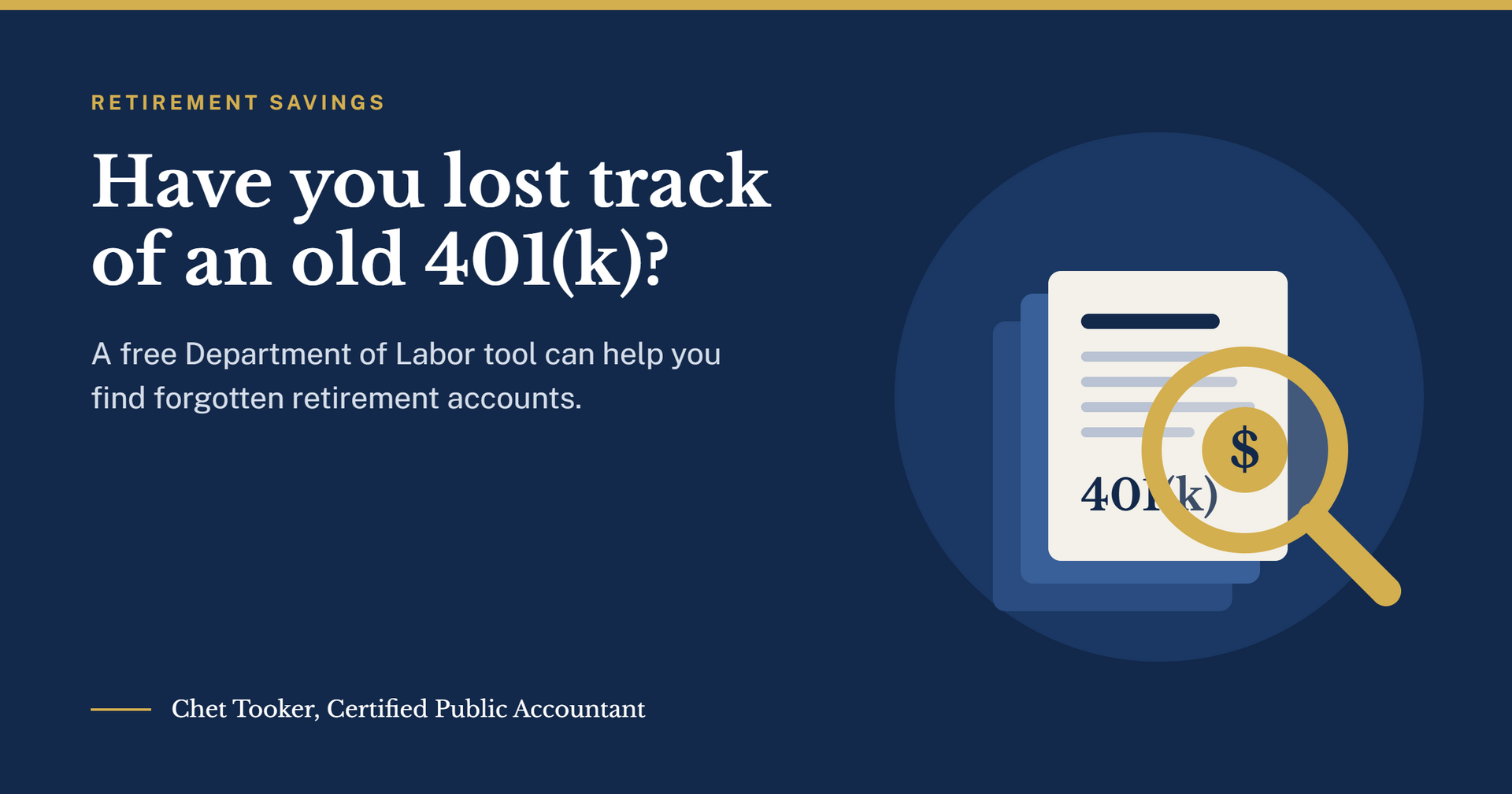
Have You Lost Track of an Old 401(k)? The Government Just Made It Easier to Find

Keep your finances organized with Chet Tooker, CPA! Contact our accountant firm today for reliable tax preparation and strategic financial advice.
Memo - Do You Watch Your Tax Preparer Complete Your Return in Front of You? That Could Be a Costly Mistake
Memo - 3 Tax Mistakes Costing Freelancers And Small Business Owners $5,000+ Per Year

